
La place des drones dans le domaine de la logistique
L’avenir des drones dans le domaine de la logistique.
La logistique, toujours en quête de réinvention, espère assouvir ce vieux phantasme de la science-fiction : livrer des colis par les airs d’un point à un autre, en toute sécurité, si possible avec peu d’intervention humaine. Fini les bouchons ou les trajets interminables sur des routes perdues et incertaines…
Pour mesurer cet intérêt, on se reportera aux annonces successives d’Amazon : Article du Figaro (16 décembre 2016) et on observera attentivement un champion plus discret, La Poste, qui a pourtant concrétisé deux expériences intéressantes et pérennes Journal du geek.com (11 novembre 2019).
Pourtant, les difficultés associées au portage sont nombreuses : pilotage, navigation et sécurité, force élévatrice, autonomie énergétique ou opérationnelle, etc.
Le drone, un transporteur multi-capacitaire
Le drone hérite du savoir-faire aéronautique militaire. Initialement utilisé à des fins d’observation, ils sont maintenant intégrés par les forces armées dans des programmes pour exploiter leurs capacités d’emport.
Le challenge technique est toujours le même et les solutions actuelles restent imparfaites :
Comment optimiser la charge utile, la durée de vol et la portée simultanément
?
Sans doute plus que pour d’autres activités, l’autonomie au sens large est un impératif pour la logistique.
Par autonomie, on entend l’autonomie physique de l’aéronef (motorisation, énergie) mais aussi la navigation autonome (qui permettra de préétablir des plans de vol pour industrialiser des trajets répétitifs en milieux stables).
Dans le domaine civil, les masses transportées sont généralement de 2 à 3 Kg, même si plusieurs projets vise de pouvoir déplacer une charge utile de 25 kilogrammes. L’exemple de l’expérimentation de La Poste évoque 3 kilogrammes transportés sur une trentaine de kilomètres.
La miniaturisation et la motorisation, fondamentales pour maximiser la charge utile du drone, ont profité des booms technologiques de l’électronique et de l’informatique. L’asymptote des progrès n’est pourtant pas encore atteinte.
Les télécommunications, un élément dimensionnant
Liaisons satellites, radio, GPS sont aujourd’hui effectives mais ces technologies présentent toujours des lacunes importantes : zones blanches, débits faibles, faible portée, systèmes hétérogènes ouverts pouvant présenter des failles de sécurité importantes.
Les cartes pourraient être rebattues avec l’arrivée de la 5G : Des débits importants, une meilleure couverture (la 5G nécessite de déployer moins d’antennes que les autres réseaux), etc. Des avancées synchrones avec celles de la voiture autonome dont pourrait bénéficier par voie interposée les drones.
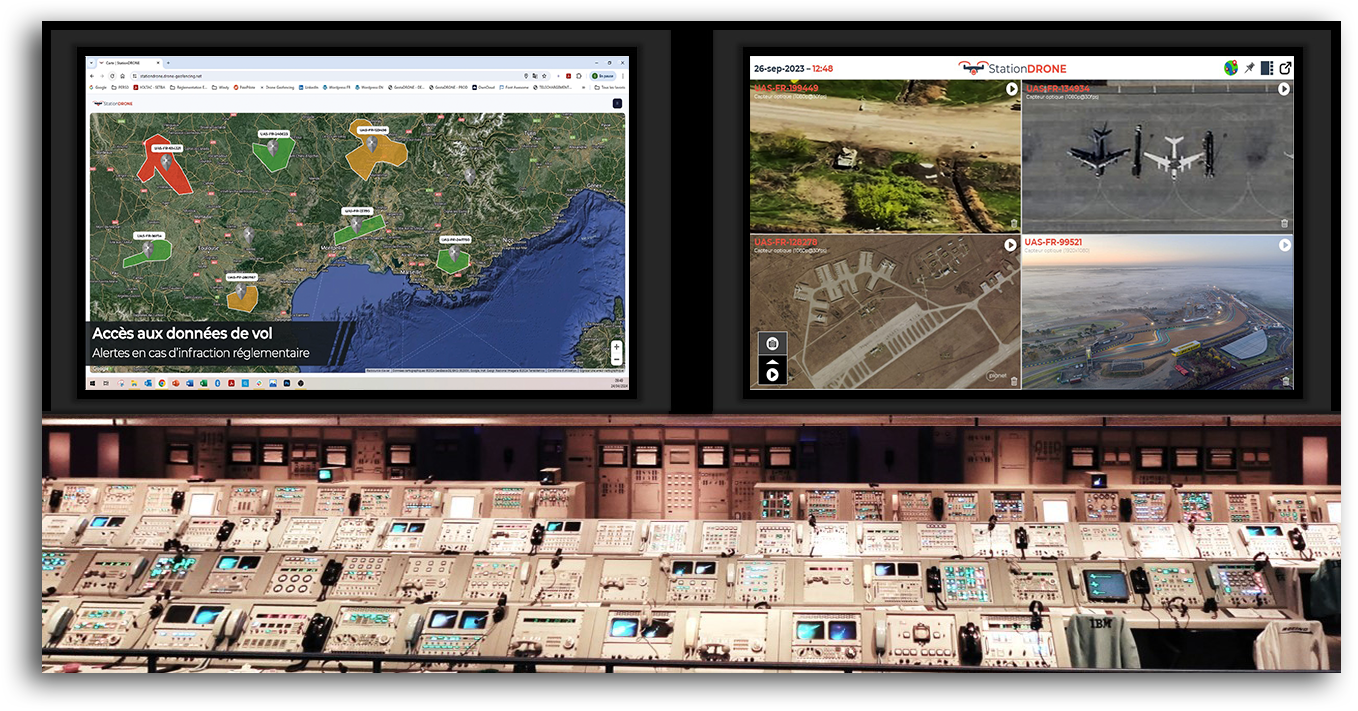
Les télécommunications sont aussi indispensables dans l’évolution du domaine de la logistique (entreprises 4.0). La chaîne de production sera automatisée de bout en bout : Depuis la commande sur le Web jusqu’à la livraison sur-mesure sur le terrain. Le drone devra alors être comme un maillon de cette chaîne numérique avec des outils de géorepérage temps réel.
L’intelligence artificielle, une technologie indispensable à la navigation autonome sous contrôle d’un centre opérationnel
Récemment, une compétition de rapidité a opposé un pilote de drone champion du monde à un drone piloté par une IA (Article Futura-sciences.com (10 décembre 2019).
Le champion humain a gagné largement, mais l’IA s’est bien comportée. Cette épreuve revisite les parties d’échecs hommes contre machines, que ces dernières ont fini par remporter. Tôt ou tard, une IA fera mieux que l’humain sur un trajet standard, et c’est enthousiasmant en logistique.
Les annonces type Uber eats et consorts (Article futura-sciences.com (3 septembre 2018) ne peuvent plus être vues comme une utopie même si dans les faits les acteurs vont se concentrer sur des objectifs plus pragmatiques (livraison en point relais et non au dernier kilomètre). En effet, si viser un point géographique est une chose, la livraison à domicile en est une autre.
A l’heure actuelle, les expérimentations sont contingentées en zones plutôt désertes, à l’aide de petites aires d’atterrissage qui servent de point de rassemblement. Cependant, les idées les plus étonnantes ne manquent pas, comme les ruches d’Amazon, qui risquent d’influencer l’architecture et l’urbanisme de demain.
Mais les français sont-ils prêts ?
Les particuliers, et les professionnels accueillent plutôt favorablement ce nouveau mode de livraison, la transformation digitale est passé par là. Cependant, la sûreté de ce nouveau mode de transport est souvent mise en cause.
Cet avis est aussi partagé par les organes de réglementation (DGAC), frileux à la libéralisation de l’espace aérien dans un contexte sécuritaire exacerbé. L’autorisation donnée à la première expérimentation de la Poste aura mis deux ans.
Les drones affectés au secteur logistique cumulent deux handicaps : (i) Par nature ils doivent approcher de zones habitées, et (ii) De par l’aspect régulier du trafic sur la ligne, les rendre autonomes est particulièrement intéressant.
Notons cependant que de nombreuses expérimentations ont été mises en place à travers le monde : Rakuten au Japon pour les Jeux Olympiques, UPS aux États Unis pour les hôpitaux, Prime Air d’Amazon au Royaume-Uni, Project Wings de Google en Australie et aux USA avec la Nasa et la FAA, (Federal Aviation Administration), etc.
Gageons que technologies et réglementation permettra de lever tous les verrous touchant à cet usage pour permettre de généraliser les exploitations BtoB ou BtoC tant attendues.