
Drones professionnels, évolution du marché et situation actuelle
D’après les derniers rapports d’activité (le dernier en date est de 2019) publiés par la direction de la sureté de l’aviation civile (DSAC), le nombre de drones professionnels enregistrés (c’est-à-dire de plus de 800 grammes) croît de manière régulière : respectivement 9 582, 13 647 et 15 946 entre 2017 et 2019. Ces aéronefs civils sont détenus par environ 8 500 exploitants de drones professionnels (constructeurs, organismes de formation, industriels, prestataires). La croissance annuelle constatée s’est donc élevée à 29,6% sur ces dernières années. Cette envolée conforte l’étude du 20 juin 2020 menée par SVP, laquelle estime la croissance annuelle du marché des drones professionnels civils à 27,2% entre 2018 et 2024.
Des drones professionnels exclusivement utilisés à l’heure actuelle pour des vols à vue
L’utilisation d’un drone est à l’heure actuelle exclusivement associé à des scénarii opérationnels nationaux (S1 – S2 – S3) en courte distance autrement dit le télépilote doit être situé à moins d’1 km du vecteur pour piloter le drone. Ce type de scénario opérationnel et les activités particulières qui peuvent y être associées répondent à des cas d’emploi très divers : (i) Médias et prises de vues aériennes (25%) ; (ii) Surveillance et sécurité civile (20%) ; (iii) BTP et inspection d’ouvrages (20%) ; (iv) Agriculture (15%) ; (v) Mines, carrières et terrassement (15%) ; (vi) Autre (5%).
Les vols de drones longue portée (entre 1 km et 100 km) et en grande élongation (+ de 100 km) sont actuellement interdits (sauf obtention d’une dérogation spécifique avec validation d’un dépôt sécurité spécifique).
Une situation en contradiction avec l’évolution des besoins des donneurs d’ordre
Si l’usage de drones civils pour répondre à des besoins dans le cadre d’activités professionnelles a été démontré dans de nombreux secteurs, la généralisation de l’utilisation de ce vecteur s’amorce difficilement car les scénarios d’emploi appellent des conditions qui en contrecarrent l’économie :
- Obligation d’avoir le télépilote (ayant la qualification élevée de pilote de drone) à proximité de son drone, ce qui compromet la baisse drastique du coût de l’heure de vol promise par la notion de vol non-piloté.
- Impact (selon la mission aérienne) sur la gestion du trafic aérien imposant l’obtention d’autorisations de vol préalable.
De nouveaux usages associés au survol de grandes distances (transport de colis, surveillance et inspection d’infrastructures linéaires, surveillance des frontières, surveillance d’environnements semi-sauvages, etc.) émergent et devraient largement contribuer à accélérer cette croissance (le coût de l’heure de vol devrait fortement baissé pour ce type de missions). Pour autant, ces nouvelles activités nécessitent :
- Des scénarii d’emploi en grande distance ET en grande élongation que ne couvrent pas les scénarii opérationnels nationaux (S-1, S-2, S-3) et les futurs scénarii européens (STS-1 et STS-2)
- Des améliorations des performances des vecteurs en termes de couple allonge / charge utile dans les plages 4-25 kg et surtout 25-150 kg (voire exceptionnellement plus) amenant des contraintes en sécurité sol (décollage – atterrissage) onéreuses en plus de l’augmentation du coût de possession des drones professionnels.
- De déployer des infrastructures de télécommunications dédiées (adaptées à chaque zone d’intervention) entre le poste de contrôle au sol et le drone afin de s’affranchir de la portée de la radiocommande du drone.
Les projections des organismes institutionnels
D’après l’étude « Perspective de développement de la filière du drone civil à l’export » écrite par la DGE, la DGAC (direction générale de l’aviation civile) et le PIPAME le 5 juin 2017, plus de 70% des vols de drones professionnels devraient être réalisés d’ici 2024 hors-vue. Cette étude est confortée par l’étude «European Drones Outlook Study » du SESAR Joint undertaking publiée en novembre 2016. Celle-ci valorise le marché européen à 400 000 drones (100 000 drones en France) d’ici 2035 dont 70% réaliseront des vols hors vue.
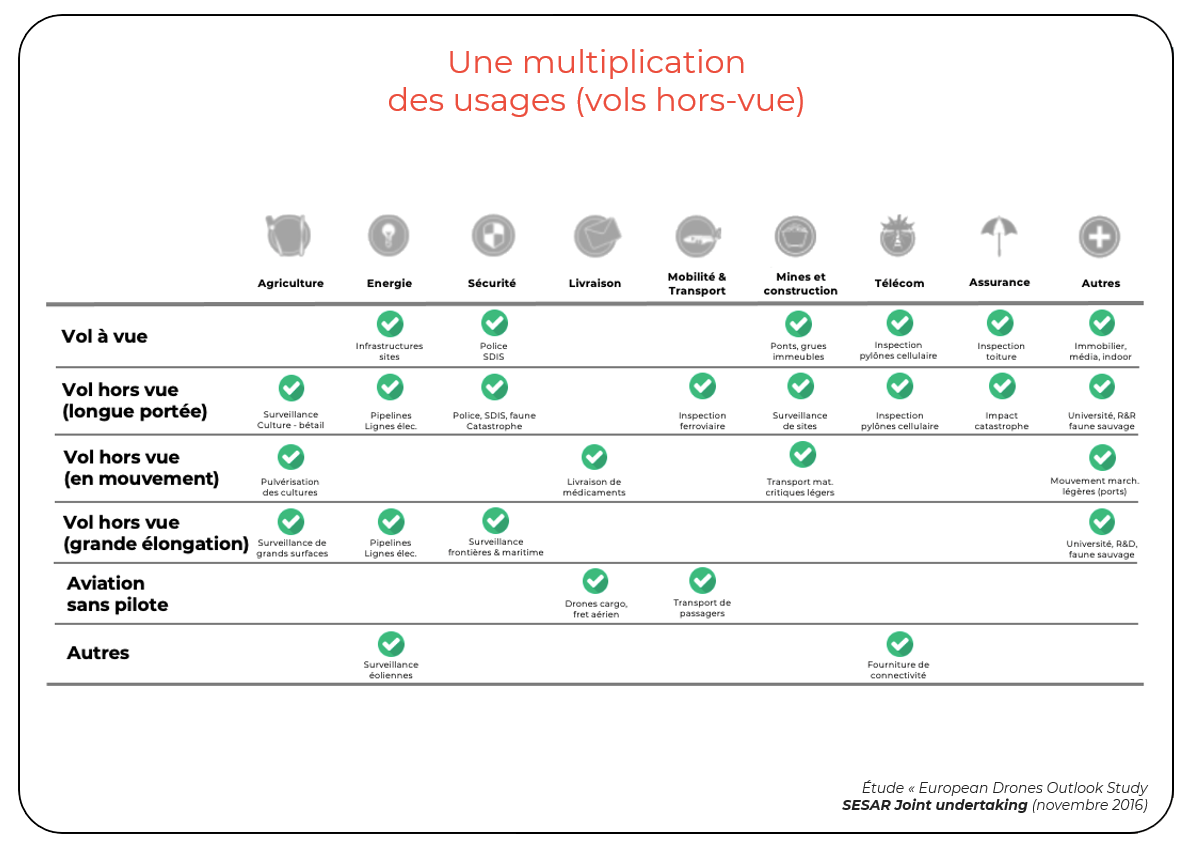
D’après nos propres projections (établies à partir des cas d’emploi en grande élongation envisagés par les deux études ci-dessus), nous estimons que les cas d’emploi en grande élongation et à grande distance devraient représenter la majorité des vols de drones civils d’ici 2028 :
- Livraison de colis (2-10 kg) en site isolé par des drones à voilure tournante (VTOL) – 7 000
- L’inspection et la surveillance d’infrastructures linéaires – 20 000
- Agriculture de précision : diagnostic agricole ou naturel – 5 000
- Surveillance d’environnement semi-sauvage (police des frontières ou sécurité civile) – 2 500
- Reconnaissance de zones dans le cadre de la surveillance des trafics : cartographie du trafic aérien – 5 000
- Agriculture de précision : épandage – 500
- Transport aérien de colis lourds (200 kg) en zones peu denses ou maritimes – 2 500
- Transport aérien de colis lourds (200 kg de charge utile) en maillage local – 25 000
- Reportage audiovisuel temps réel : prise de vue et imagerie aérienne – 500
- Autres cas – 12 000
Alors quels sont les verrous à lever pour envisager des scénarios de vol à grande élongation ?
La fiabilité intrinsèque des appareils devrait permettre l’utilisation des drones et la réalisation de ces missions en toute sécurité d’ici quelques années. Les principales difficultés identifiées à date concernent :
- La sûreté et la qualité des télécommunications à établir entre le drone et le poste de contrôle au sol ;
- L’autonomie du drone en vol au travers de la capacité de la carte de pilotage automatique à gérer notamment les risques air (détection d’objets mouvants dans l’espace aérien et recalcul en temps réel des trajectoires).