
Drone pilot training organizations
Drone pilot training: what market does it offer?
According to the DSAC activity report, 12,272 drone pilots were qualified as of December 31, 2019 (3,113 more than in 2018).
The annual market for training these professional French drone pilots is estimated at around ten million euros. It is divided among some forty providers (registered with the DGAC) with varying characteristics:
- Around ten centers exclusively dedicated to training drone remote pilots
- Some drone manufacturers have opened a drone pilot training academy.
- Around twenty service companies currently provide drone pilot training.
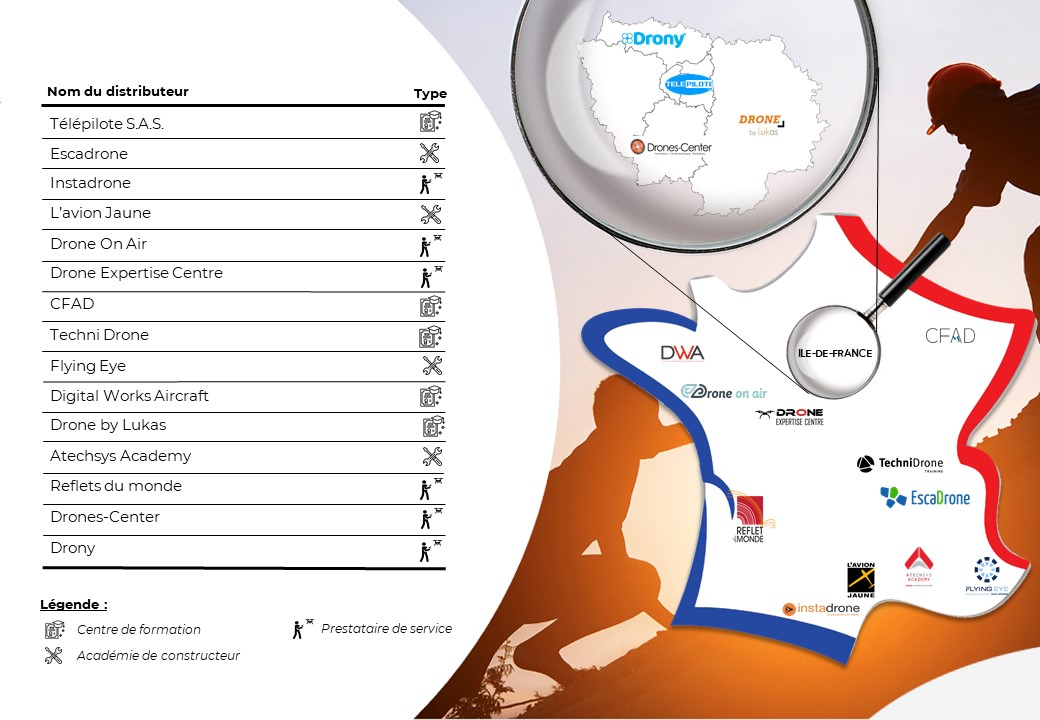
List of the main French training organizations
Below, we have listed the fifteen largest players in the French drone training sector. The proximity of training centers to trainees is an important factor. The map below shows the geographical location of their headquarters (keeping in mind that some organizations operate several training centers).
Drone training and the drone operator market in France
The market for drone operators specializing in specific activities has exploded in France in recent years. At the end of 2019, there were over 8,500 companies officially registered with the DGAC (French Civil Aviation Authority) as operators of civilian drones. The annual growth in volume of this market is over 301,000. Every drone training center is aware of this and offers a range of services combining various courses and customized drone training programs (comprehensive training, theoretical and practical courses) with the aim of issuing certificates of competence to pilot a professional drone (certificate of competence, certificate of completion).
- Beginner theoretical training (theoretical knowledge, how to become a pilot and learn to fly), expert theoretical training (ULM theory, MCQs);
- Practical training, piloting of specific drones (introduction to piloting, training in the use of drones, aptitude for the functions of remote pilot of specific drones);
- Professional development (increasing qualifications and improving skill level)
- Mandatory training on the new regulations
- Use of specific sensors (optical camera, lidar, multi-spectral camera);
- Image interpretation and analysis.
The activities of aircraft operators are distributed as follows:
Over 100,000 flight hours for drone pilots in the communications and audiovisual sector:
- Aerial filming for cinema, news and media.
- Aerial photography
- Advertising videos and films
- Recreational and communication drones for businesses
Over 50,000 flight hours for remote pilots in the construction and civil engineering sector, including overflights of regulated airspace (the use of a civilian drone is much easier to implement and less expensive than using a helicopter):
- Aerial photography for real estate
- Aerial photography in civil engineering. Aerial photography for public works, structural inspections, industrial sites, and mapping.
- Infrastructure and network inspection. Control and inspection of transport and energy networks such as electrical networks, pipelines, or oil pipelines.
- Inspection of oil and mining sites
- Inspection of telecommunications network installations and mobile operators.
Source of information: DGAC (French Civil Aviation Authority).