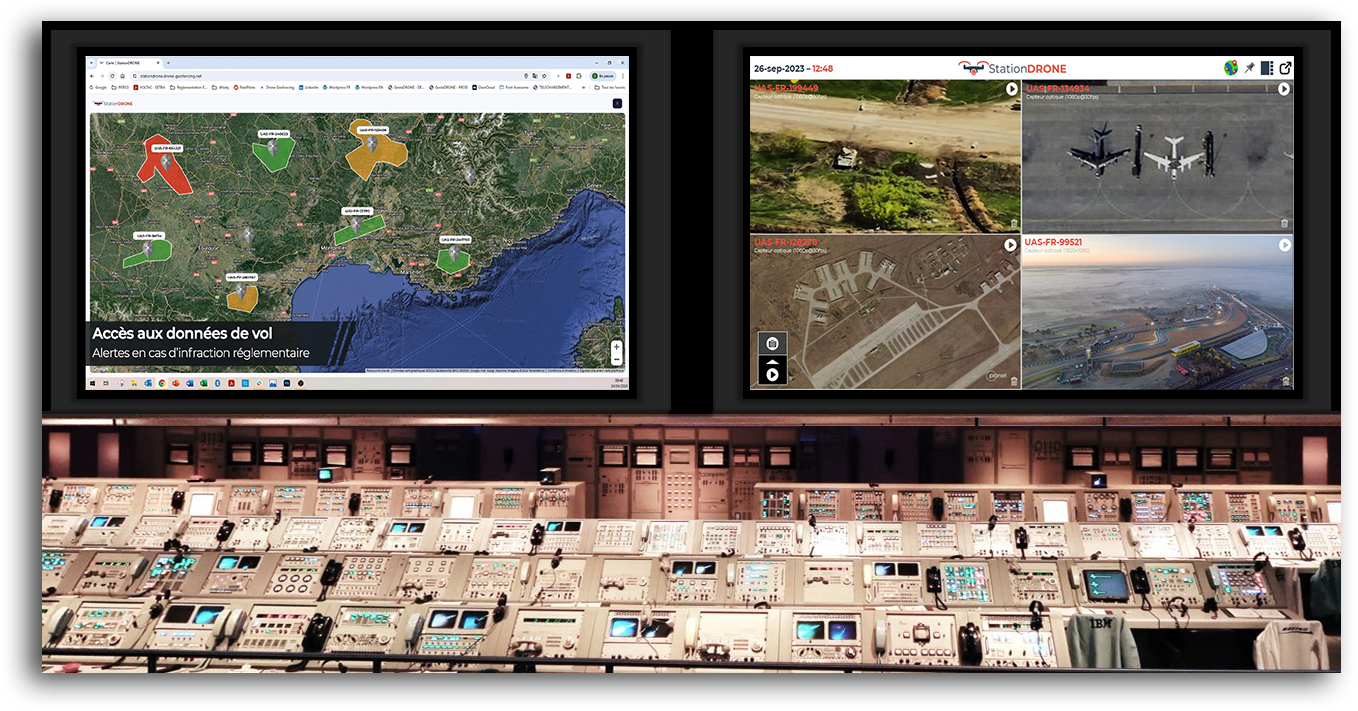

Drone airspace, drone legislation: what you need to know.
Drone airspace begins from the first meter above the ground. It is divided into 2 large, distinct spaces.–Above 150 meters (500 feet) above ground level, it is reserved for airplanes and other manned aircraft. Below 150 meters, it is reserved for drones.
The area reserved for drones is subject to numerous restrictions (www.geoportail.gouv.fr): (i) Prohibited area (such as sensitive site), (ii) Army tactical flight corridors, (iii) CTR (areas near airfields).
The Directorate General of Civil Aviation (or DGAC)
The French Civil Aviation Authority (DGAC) is responsible for ensuring the safety and security of air transport: (i) Defining French air regulations, and (ii) Ensuring the security of air traffic control using primary and secondary radars. To control airspace, the DGAC relies on two types of radar:
- Primary radars. These are conventional radars that illuminate a large area with a magnetic wave and receive in return the waves reflected by targets within that area. The term therefore refers to a radar system used to detect and locate potentially uncooperative targets.
- Secondary radars. These are air traffic control radars that "interrogate" the sky. The electronic equipment on board aircraft (transponders) within radar range then transmits the aircraft's flight information: position, flight level, speed, etc. The aircraft's responses are: (i) Captured by the secondary radar antenna, (ii) Analyzed and processed electronically, and (iii) Displayed on air traffic controllers' screens.
Surveillance tools unsuitable for drones
Experience has shown that both types of equipment are unsuitable for airspace surveillance (below 500 feet), particularly for monitoring drone flight operations:
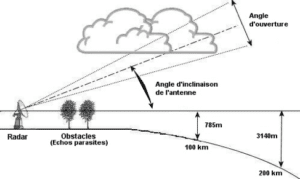
- Primary radar coverage includes a "« dead zone » close to the ground, especially in the case of significant terrain and obstacles.
- Drones are not not equipped with transponders.
Deploying them on drones is impossible because these devices are heavy and emit at a power of 160-250 W, which is not in compliance with the regulations for free frequency bands (500 mW) particularly in urban areas.
Drone regulations were put in place as a palliative measure.
To address the lack of technology for monitoring airspace below 500 feet, the DGAC has implemented very restrictive regulations.
Drone flights are permitted under specific conditions (risk taken well identified and very limited (low mass drones operating close to the ground outside inhabited areas most generally within sight of the remote pilot).
Since January 1, 2018, any drone weighing more than 800 grams is considered a professional drone. Operators must systematically to obtain a flight authorization with the DGAC before each mission.
These administrative authorizations are time-consuming and require extensive advance planning for drone flights. This involves: (i) Submitting certain activity declarations, (ii) Obtaining authorizations from the prefecture prior to flights, and (iii) Being able to present certain documents in case of inspection.
The attached website describes these obligations in detail: www.ecologique.gouv.fr/drones-usages-professionnels.